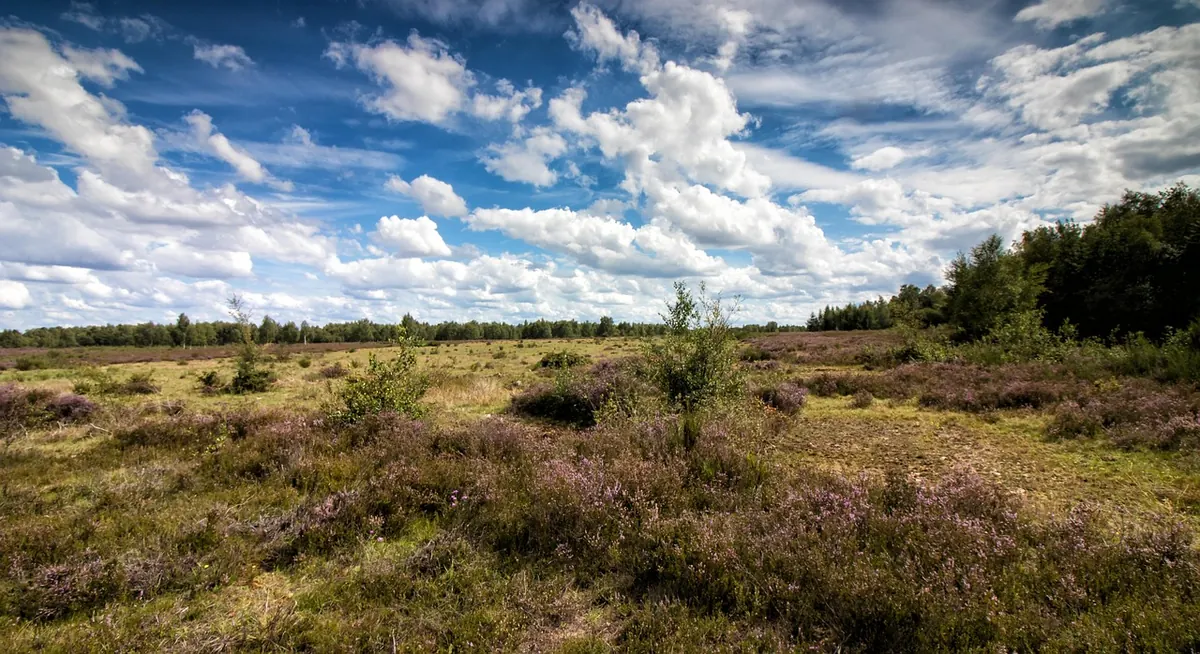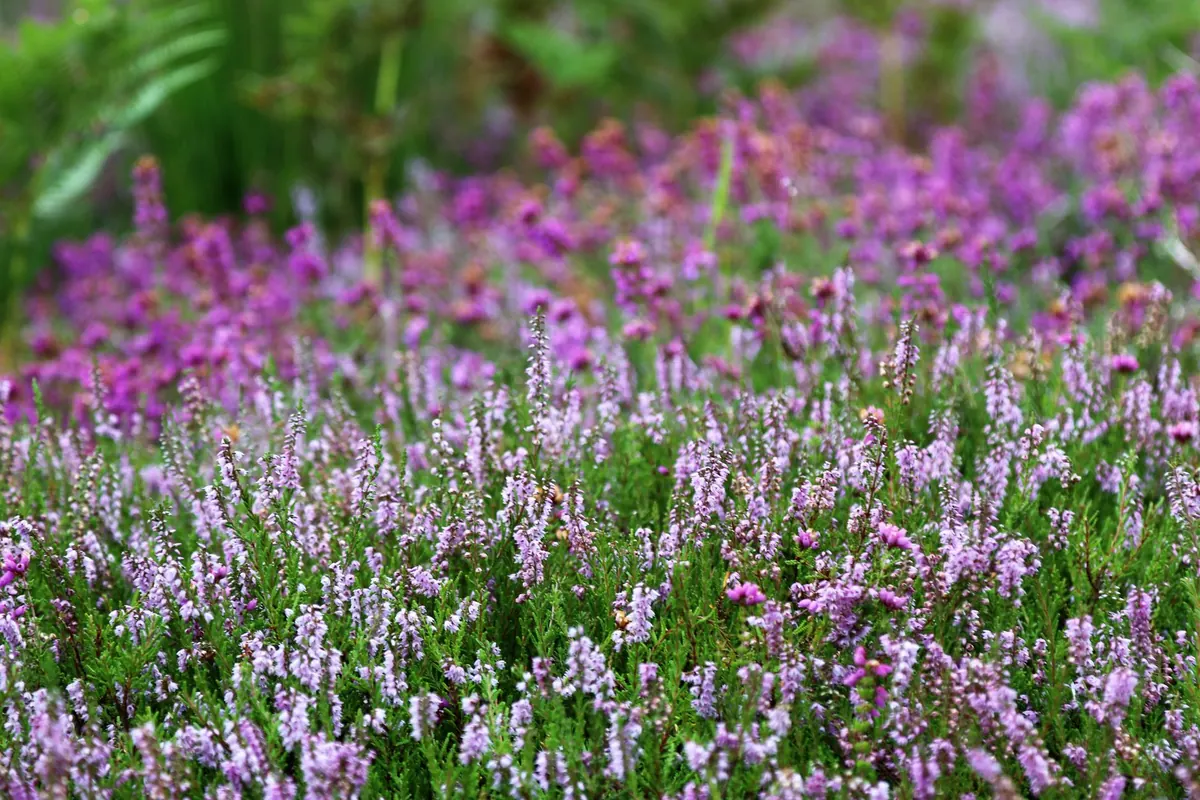
Late August is when a lowland heath stops being a blur of purple and becomes a set of separate plants. Ling is opening across the drier ground, gorse is either flowering hard or standing dark and dull, and bracken is beginning to turn from green to the rust colour that will own the place by October. Walk the same path three weeks apart and the balance shifts.
The trick at this time of year is to stop identifying by colour alone and start looking at structure: how the leaves sit on the stem, how tall the bush is, whether the flowers are fresh or over. Here is a beginner's route through the species you are most likely to meet, with cues you can check without a hand lens.
Start with the heathers: three species, three habits
Ling, or common heather (Calluna vulgaris)
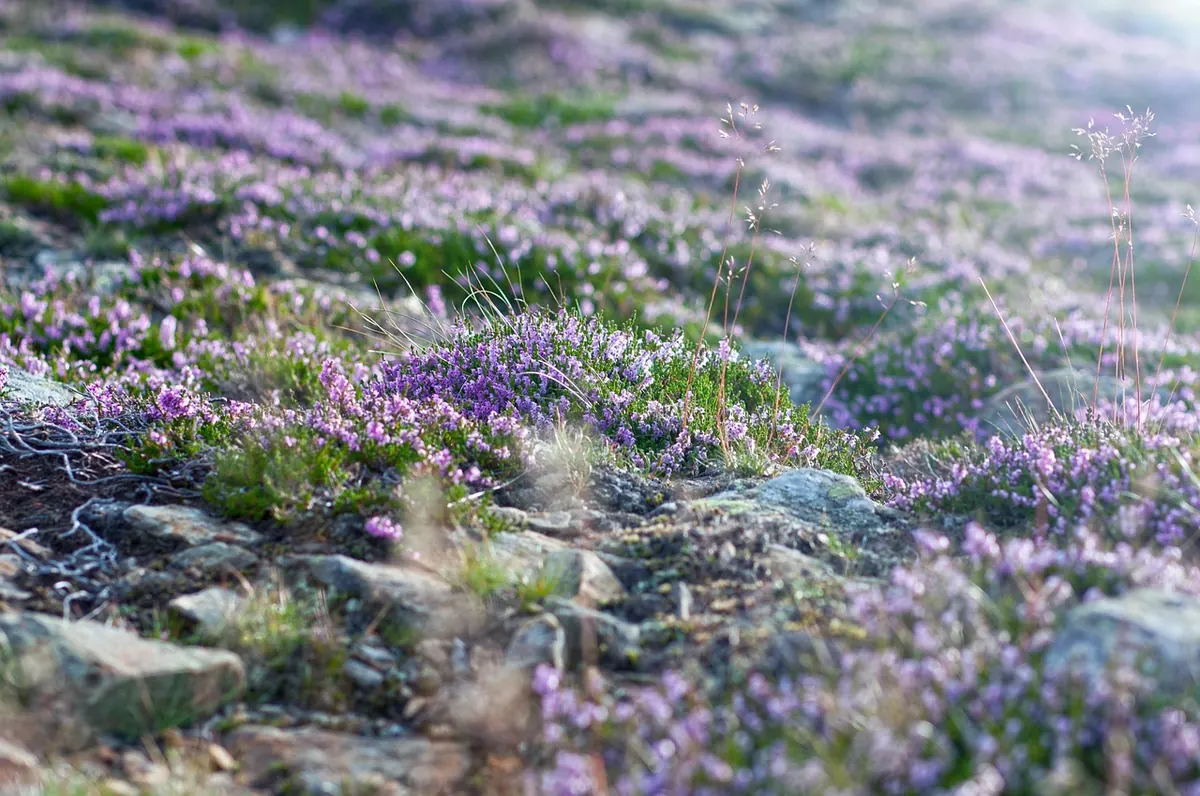
The one that turns whole hillsides purple in August. Look closely and ling's leaves are tiny, scale-like, held in overlapping opposite pairs that run in rows up the shoot, giving it a slightly knobbly, thread-like look. Flowers form dense spikes along the upper stem and are usually pale purple-pink, sometimes white. Each flower is four-parted, with petals shorter than the sepals — a useful distinction from the other heathers. Peak flowering is August into September, so if it is in full bloom now, that is a strong clue.
Bell heather (Erica cinerea)
Darker, more magenta, and mostly finished by mid-August. Its leaves are short needles arranged in threes up the stem; roll a shoot between finger and thumb and it feels angular rather than soft. Flowers hang in loose clusters near the top, bell-shaped with a slightly swollen base, and the petals are longer than the sepals. On a fresh bell heather flower the thin central style pokes out beyond the mouth of the bell.
Cross-leaved heath (Erica tetralix)
The wet-heath species. Its grey-green leaves are arranged in whorls of four, so seen from above they make a neat cross at intervals along the stem. Flowers are pale pink, rounded, held in a tight cluster at the top, and noticeably sticky and hairy. Peak is July to early September, in boggy hollows and damp flushes. If you are standing on dry, crisp ground, this is probably not what you have.
Gorse: read the bush, not the flower
Common gorse (Ulex europaeus) is the tall one — often chest-high or more, dark green, with long, thick, deeply grooved spines and stems that turn brown with age. It flowers mainly from late winter into spring, though stray blooms appear all year. In late summer most bushes look tired: dense, dark, and carrying only a few yellow flowers low down.
Western gorse (Ulex gallii) and dwarf gorse (Ulex minor) are the late-summer flowerers. Both are low, ankle to knee high, and mat-forming. Western gorse is darker and denser, more at home on western and coastal heaths, and flowers from August into autumn. Dwarf gorse is a little brighter and finer, flowering roughly July to September, mostly in the south and east. From a distance they look alike; up close, dwarf gorse has smaller spines and a more open, wiry habit.
- Check height first. Tall, woody, shin-high bushes flowering sparsely in August are almost always common gorse out of season.
- Then look at the flowers. Bright yellow flowers on low, sprawling bushes at the end of summer point to western or dwarf gorse.
- Crush a flower. Gorse smells faintly of coconut — a pleasant confirmation, never an identification on its own.
- Notice the green. Common gorse is dark and dull; dwarf gorse is lighter and yellow-green.
Bracken: the fern that redraws the map
Bracken (Pteridium aquilinum) is not a shrub, but in late summer it dominates whole slopes. The fronds are large, roughly triangular, and divided into three main branches, each held in its own plane — the classic three-way structure. The lowest pair of leaflets carries an extra, downward-pointing branch, which gives the frond its bracken-shaped footprint. Spores form in a continuous line along the curled-under edge of the leaflets in late July and August.
By September the green starts to go. Colour moves from yellow-green to straw, then rust, and dead fronds collapse into a deep litter that smothers almost everything beneath. That litter layer is why heathland managers cut or bruise bracken, and why a bracken stand tends to stay a bracken stand.
Two sensible cautions. Bracken releases spores in late summer, and dense stands can be dusty; if you are sensitive, keep your face out of them and avoid working in bracken on still, dry days. Bracken is also toxic if eaten, so leave the fronds out of anything you plan to consume.
The supporting cast worth knowing
Purple moor-grass (Molinia caerulea)
Tussocky, with purple-black flower spikes on stiff stems, growing where the heath gets damp. Late summer is its season, and knee-high tussocks are a good sign you are on wet heath rather than dry.
Tormentil (Potentilla erecta)
Small yellow flowers with four petals — most of its relatives have five — on creeping stems along paths and in short turf. It flowers on and off into September.
Sheep's sorrel (Rumex acetosella)
A wash of tiny crimson spikes over bare, disturbed ground, with small arrow-shaped leaves that have lobes at the base.
Common dodder (Cuscuta epithymum)
A parasitic plant with no green leaves at all, just tangled red threads draped over gorse and heather. In late summer it is obvious, strange and worth looking for.
Cup lichens (Cladonia species)
Grey-green, stalked and goblet-shaped on patches of bare ground. Where these appear, vegetation has been grazed short or disturbed — a handy clue that you are looking at open, early-stage heath.
Putting it into practice
A short routine for a first visit:
- Stand still and split the vegetation into layers: purple or magenta flowers, yellow flowers, yellow-green fern, grasses.
- Pick one puzzling plant and check the leaves before the flowers. Leaf arrangement survives flowering; petals do not.
- Note the ground under your boots. Cross-leaved heath and purple moor-grass mean wet; ling, sheep's sorrel and cup lichens mean dry.
- Photograph a whole bush, a single shoot, and a flower, then check the identification at home.
- Stay on the paths where you can. Heather and lichen recover slowly from trampling, and adders use the sunny edges.
Identification gets easier with repetition, and late summer gives you two chances: an August round while ling and the low gorses are in flower, and a September one when bracken has turned and the differences in structure are all that is left to go on. Take the same route both times. By the second walk you will be naming plants before you reach them.
Photo: Expect Best / Pexels