A lowland heath in July is noisy with insects, and two butterflies cause most of the arguments. Both are smallish, both are brownish when they close their wings, and both live on the same patch of heather and gravel. One is a restless little blue that rarely leaves its colony; the other is a big, cryptic brown that appears out of nowhere and disappears the moment it lands. Knowing the flight period, the wing pattern and the exact spot each one favours will settle the identification in a few seconds.
The Calendar Does Half the Work
The silver-studded blue has a short season. In most British colonies it is on the wing from the second half of June to early August, with the peak in the last days of June and the first fortnight of July. A few warm southern heathland colonies produce a partial second brood later in the summer, but the main showing is over by mid-August.
The grayling starts at roughly the same time and keeps going much longer. Fresh individuals appear from late June or early July, numbers build through August, and the butterfly is still flying on southern and coastal sites into September, sometimes well into the month. There is one brood, but it is stretched out.
That leaves July as the awkward overlap, when both can turn up within a few metres of each other. Outside that window the calendar is a strong filter. A small blue butterfly in May is not a silver-studded blue, and a brown butterfly on a heath in October is not a grayling.
Size and Flight Style
Silver-studded blues are genuinely small, with a wingspan of roughly three centimetres. They fly low, a few inches above the heather, in a busy, fluttering hop that rarely carries them more than a short distance. Watch one for a minute and you will see it return again and again to the same few square metres. Colonies are tight, and the butterflies can seem almost reluctant to cross a track.
Graylings are two or three times the bulk. They sit with wings closed and look like a scrap of bark or lichen until something disturbs them, at which point they explode upward, fly fast and erratically, and drop back to bare ground a short way off. If your first view is a sudden brown shape flying away from your feet, you are almost certainly looking at a grayling.
Reading the Wings
Underside: the view you will actually get
Most settled butterflies show only their undersides, so this is the view that matters. A resting silver-studded blue is grey-brown with a row of black spots near the wing edge, each ringed with pale scales, and a band of orange spots just beyond them. The name comes from the row of black spots on the hindwing underside, which are dusted with iridescent silver-blue scales. Those metallic flecks are the clincher. They are small, so get close, or use close-focusing binoculars.
A resting grayling is a different creature altogether. The underside is mottled grey, brown and cream, broken up like weathered stone. The forewing carries a large dark eye spot with two tiny white dots inside it — occasionally just one — and a smaller eye spot sits on the hindwing. Where the silver-studded blue looks neat and spotted, the grayling looks smeared and camouflaged.
Upperside: the quick view
When a silver-studded blue opens up in early morning sun, the male is a clear violet-blue with a dark border. Females are brown, and on southern heathland colonies many show a wash of blue over the hindwings, which catches people out. The grayling never opens its wings at rest, so an upperside view means a flying insect: greyish brown with orange patches and dark eye spots on the forewing.
Where Each One Turns Up
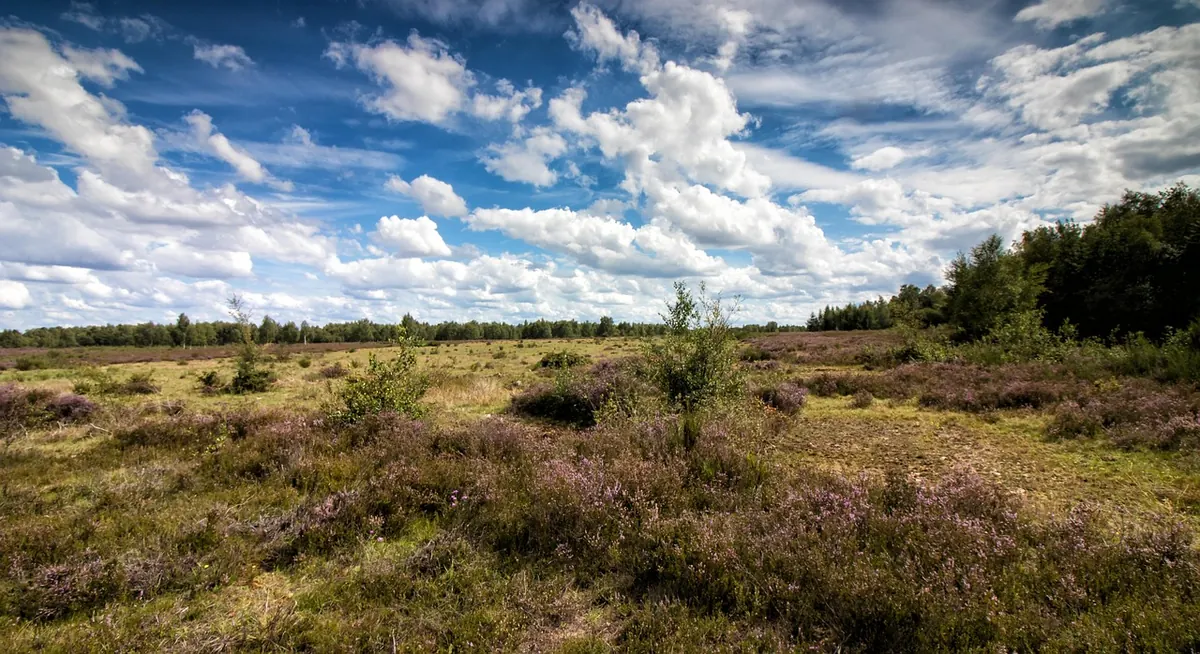
The two species share a habitat type but not a microhabitat. The silver-studded blue needs short, recently grown or heavily grazed heather, warm sheltered slopes, anthills, track edges and patches of bare ground close to cover — its caterpillars are tended by ants, so ant nests matter as much as nectar. The grayling wants the opposite emphasis: open, sparsely vegetated ground where it can bask on stones, lichen, shingle or dry earth.
- Silver-studded blue: lowland heath in Dorset, Hampshire, Surrey, Sussex, Suffolk and Norfolk; also some coastal dunes, a handful of Welsh and Shropshire sites, and a few chalk or limestone colonies.
- Grayling: dry heath, sand dunes, shingle beaches, clifftops and chalk downland, with a strong coastal bias — the south and west coasts, East Anglian sandlings and a scattering of inland heaths.
- On a shared site: look for the blue among the heather stems and over ant mounds; look for the grayling on the bare, stony ground between the bushes.
Behaviour: The Tell That Settles It
The grayling has a habit no other British butterfly shares in quite the same way. When it settles, it closes its wings, tilts them towards the sun and often sits head-down, so that its shadow shrinks to almost nothing. It will land on a footpath, a lichen-covered stone or a bare patch of gravel with complete confidence. It also flies up to investigate passing butterflies, including your hat.
A silver-studded blue settles lower in the vegetation, usually on heather or grass, wings closed. On cool mornings it will bask with wings partly open, angled to catch the sun, which is your best chance of a clean look at the upperside. It is not a wanderer. If a small blue is flying strongly across open ground away from any heather, question the identification and consider a common blue or a small blue instead.
Getting Your Eye In on the Day
Heathland butterflies are easy to disturb and slow to settle, so approach the whole exercise calmly. A few habits make a real difference:
- Keep the sun behind you or to one side, so you are not walking into your own shadow or into the insects.
- Scan the bare ground ten metres ahead before you move. Graylings are often visible as small, dark, triangular shapes on gravel.
- Check the heather tops next, particularly on south-facing edges and around anthills, for low fluttering blue shapes.
- Watch a settled butterfly for half a minute before moving closer. Flight style and the tilt of the wings are as useful as any marking.
- Stay on paths and wide tracks. These colonies are small and local, and trampling the heather structure does lasting damage.
If the date is late June or July, both species may be present, and the distinction is easiest at rest: a neat grey-brown underside with metallic silver-blue studs and orange spots is the blue, while a mottled stone-coloured underside with a large two-dotted eye spot is the grayling. Everything else on the heath that day is a bonus.
Photo: Skica911 / Pixabay