Nightjar or Dartford Warbler? How to Tell Heathland Night Sounds Apart
Half past nine on a July evening on a lowland heath, and the second shift is starting. The linnets have gone quiet, the last woodlark has dropped out of the sky, and then it arrives: a low, dry, mechanical purring from somewhere beyond the birch belt. Or is it the scolding buzz of a small brown bird on top of a gorse bush twenty feet to your left? Both land in the ear as "churring". Telling them apart comes down to length, texture and timing, and you can learn all three in one evening.
Before you go: timing and a still night
Two things decide whether you hear anything at all — the date and the weather. Nightjars arrive from Africa in late April and May and churr at their best from mid-May to early August. Dartford warblers are here all year and sing hardest between March and July, with a quieter run in late summer.
Pick a warm, still, dry evening. A light breeze can flatten a nightjar's churr at fifty metres, and rain shuts most birds up entirely. The half hour after sunset and the hour before dawn are the money. Get there with time to spare, walk slowly, and then stop for at least ten minutes somewhere with open heather in front of you and scattered pines or birches behind. Standing still beats walking every time.
It also helps to know your heath before dark. In daylight, look for the two birds' favourite perches: nightjars like a low, bare branch or a fallen pine trunk with a clear take-off lane, while Dartford warblers prefer the highest sprays of gorse and heather. Returning to those spots at dusk gives you a head start on interpreting whatever you hear.
The nightjar's churring: a machine in the dark
Nightjar churring is a sustained, hypnotic roll, and its most striking quality is how long it lasts. A male working from a favourite perch will churr for fifteen, thirty, sometimes sixty seconds without a real break, then pause and start again. Think of a two-stroke engine idling a long way off, or a cat purring into a microphone. The sound is made of rapid pulses packed so tightly you hear one continuous tone rather than separate notes, and it often shifts gear: the churr drifts up in pitch, holds, then drops back, all without stopping.
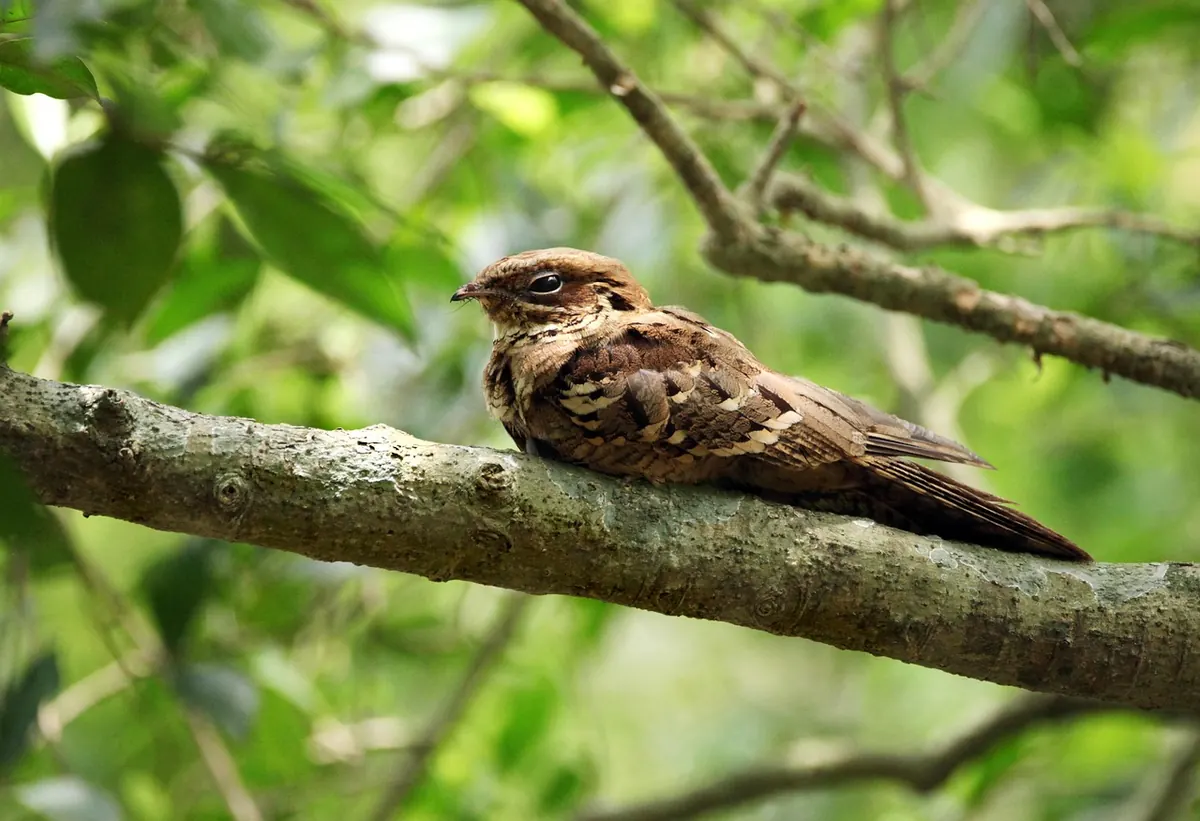
Because it carries so well on still air, distance is easy to misjudge. A bird you can hear clearly may be a hundred metres away on the far side of a clearing. Look for a low, horizontal branch at the edge of the trees, or a fallen pine with a clear view. When the bird leaves the perch you may catch a soft, sharp flight call — a "quoick" oddly like a small stone dropping into water — and sometimes a single dry wing clap. By day, nightjars are silent.
If you have a phone, record a burst and watch the waveform. Nightjar churring looks like a thick, unbroken band; Dartford warbler scolding looks like a row of short, jagged blocks. You do not need the software to identify the bird, but it is a useful way to train your ear after the event.
The Dartford warbler's rasp: short, scratchy, impatient
Set a Dartford warbler against that and the difference is duration and grit. The call note people describe as a churr is a short, buzzing scold, usually under a second, more "tchurr" than purr. You hear separate, scratchy elements rather than a smooth roll. Its song is a hurried, rattling warble of two or three seconds, full of dry, buzzy notes and delivered from the top of a gorse bush or a tall heather stem, the long tail cocked up as it sings.
The practical point: Dartford warblers sing in daylight. If the churring reaches you at three in the afternoon, or from a bush-top bird that keeps flicking its tail between bursts, you have a warbler. An agitated Dartford warbler can keep up a hard, scolding tchurr-tchurr-tchurr while you stand still, but it will not sustain a single unbroken roll the way a nightjar does. If you can count the pauses, you are almost certainly listening to a warbler.
Field marks for the ear: five things to listen for
- Length of burst. Nightjar: 15–60 seconds, often longer. Dartford warbler: usually less than a second per scold, or a 2–3 second song.
- Texture. Nightjar: smooth, oily, mechanical purr. Dartford warbler: dry, scratchy, buzzy, with audible grit.
- Pitch movement. Nightjar: may rise, hold and fall in a slow arc. Dartford warbler: stays in a narrow, impatient rattle.
- Timing. Nightjar: dusk, night and pre-dawn, rarely full daylight. Dartford warbler: mostly daylight, especially morning and late afternoon.
- Context. Nightjar: often unseen, from a low perch or in flight over open heath. Dartford warbler: a visible brown bird on top of gorse, tail cocked, wings flicking.
What else churrs, buzzes or ticks on a heath at night?
Not every night sound belongs to these two species. Grasshopper warblers reel from dense scrub, a dry, insect-like whirr that can last for minutes, but it is higher, thinner and more hiss than purr. Crickets and bush-crickets fill the gaps with ticking and lisping calls that are easy to mistake for tiny birds until you notice the relentless, robotic regularity. A woodlark may sing at night, but its voice is fluty and descending, not a mechanical churr. Tawny owls, nightingales and even distant sedge warblers can muddy the picture, so always ask: is the sound coming from a perch, a bush-top, the ground, or the air?
And if you hear a sharp quoick over your head in near-darkness, look up rather than across. Nightjars often call in flight, and a silent silhouette with long wings and a long tail is its own field mark.
A one-evening practice plan
- Arrive 45 minutes before sunset and walk the route quietly while you can still see perches.
- Choose a stop with open heather in front and taller scrub or trees behind you.
- Stand still for ten minutes. Resist the urge to move towards the first sound.
- When a churr starts, time it. Count seconds until the first real pause.
- Ask whether the sound is continuous or made of separate scratchy notes.
- Use a red-filtered torch only if a bird is already visible, and never shine it at a nest or a singing perch.
- Note the conditions: wind, temperature, time and cloud. Patterns will emerge over several visits.
Etiquette and the law: listen without disturbing
Both nightjars and Dartford warblers are protected in the UK, and disturbing them at or near a nest can be an offence. Nightjars are Schedule 1 birds, and Dartford warblers are also specially protected. That means no playback, no repeated approaches, no trampling into heather, and no dogs off the lead during the breeding season. Stay on paths where they exist, keep your distance, and let the bird choose whether to keep singing.
Listen more, walk less, and let the bird finish its sentence.
Quick comparison at a glance
- Nightjar: sustained 15–60 second purr; smooth and mechanical; pitch drifts; after sunset and before dawn; often unseen or in flight.
- Dartford warbler: short tchurr scolds or a 2–3 second rattling song; scratchy and dry; daylight; bush-top bird with cocked tail.
Once you have heard both in the same evening, the confusion drops away. The nightjar is a machine running somewhere in the dark; the Dartford warbler is a small, impatient bird telling you exactly where it is. Listen for length first, then texture, then timing — and the heath will start to sound less like a puzzle and more like a conversation.
Photo: mudronbidrashed / Pixabay